Currency trading, made simple
We understand that different clients have different needs, which is why we offer a wide selection of powerful, sophisticated trading platforms to choose from.
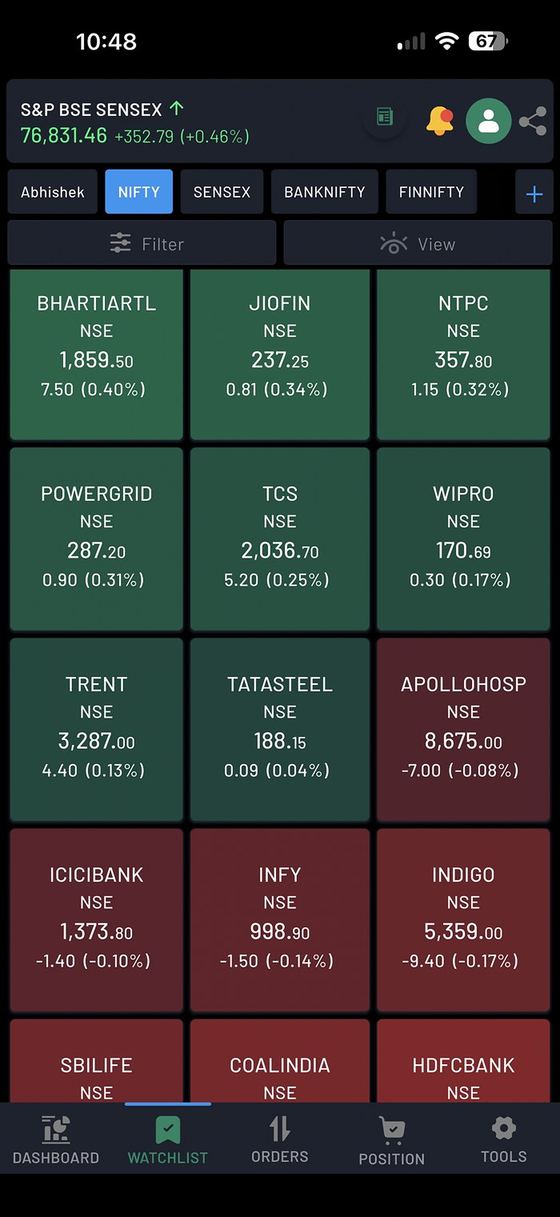
Trade currency derivatives on the go with our mobile application and benefit from ultra-low-latency infrastructure, fast order execution and intelligent tools.
Importers and exporters can use currency derivatives to hedge their offshore payments and receipts — safeguarding themselves from unexpected currency movements.
- Major currency pairs
- Fast execution & low latency
- Access to NSE & BSE
- Hedging for import/export exposure
Understanding Currency in detail
How currency derivatives work
You trade futures and options on currency pairs — such as USDINR — in the exchange currency-derivatives segment on the NSE and BSE. Contracts are standardised with fixed lot sizes and margins.
Two reasons to trade currency
To take a view on exchange-rate movements, or to hedge a real exposure. Importers, exporters and anyone with offshore payments or receipts use currency derivatives to protect themselves from adverse currency moves.
What drives exchange rates
Interest-rate differentials between countries, inflation, the trade balance, crude oil prices and global capital flows are among the biggest drivers.
Keep in mind
Individual currency moves can look small, but leverage amplifies both gains and losses. Always trade with stop-losses and sensible position sizing.
Understanding Currency
Who trades it
Traders seeking diversification, and businesses hedging import/export exposure.
Key drivers
Interest rates, inflation, trade balance and global capital flows move exchange rates.
Hedging
Importers and exporters lock in rates to protect margins from currency swings.
Why Trade Currency with PCJ
Fast Execution
Ultra-low-latency trading infrastructure.
Powerful Platforms
A range of sophisticated platforms.
Hedge Currency Risk
Protect offshore payments & receipts.
Trade on Mobile
Currency derivatives on the go.
Tools You Get With PCJ
Strategy Builder
Build option strategies with pay-off charts & Greeks.
Market Depth
Live bid/ask, 52-week range, volume & OI.
Basket & SIP
Order multiple stocks or set SIPs in one go.
Smart Alerts
Price alerts so you never miss a move.
Charts & Data
30 years of history, ratios & indicators.
Safe & Secure
NSDL demat, OTP-based pledges & alerts.
Trade vs Hedge
Trade
Hedge
Begin in Three Simple Steps
Open your account
Complete a 100% online, paperless Demat & Trading account in about 10 minutes.
Meet your RM
Get a dedicated Relationship Manager for guidance and service support.
Start with Currency
Select a currency contract, review the data, and place your order.
Currency — Frequently Asked Questions
Contracts to buy or sell a currency pair at a future date — used by traders for a view on exchange rates and by businesses to hedge.
Traders seeking diversification and importers/exporters hedging offshore payments and receipts.
Major currency pairs available in the exchange currency-derivatives segment.
USDINR is the most traded; EURINR, GBPINR and JPYINR are also available.
Yes — importers and exporters can use currency derivatives to manage exchange-rate risk on offshore payments and receipts.
Yes, they trade on margin, so both gains and losses are amplified — use risk controls.
Futures and options are contracts whose value depends on an underlying share or index. A future is an agreement to buy or sell at a fixed price on a future date. An option gives you the right — but not the obligation — to do so, for a price called the premium. They are tools for hedging and trading, and they carry leverage, which magnifies both profit and loss.
Very. SEBI's own study found that about nine out of ten individual F&O traders lost money, with sizeable average losses. Leverage means a small market move against you can wipe out a large part of your capital. If you still want to trade derivatives, start small, learn payoff structures, always use stop losses, and never trade with money you cannot afford to lose.
Margin is the deposit the exchange requires you to keep with the broker to take a leveraged position. It ensures you can honour your obligations if the market moves against you. Margins change with volatility, and if your losses eat into the margin, you get a margin call asking for more funds — failing which the position may be squared off.
SEBI requires brokers to collect income proof before activating derivative segments because F&O involves leverage and is suitable only for investors who can bear the risk. A recent salary slip, six months' bank statement, ITR acknowledgement or demat holdings statement usually works.
Muhurat trading is a special one-hour trading session that exchanges hold on Diwali evening, considered an auspicious time to invest. The exact timing is announced by NSE and BSE each year. It is a symbolic session — liquidity is thinner than normal hours, so trade thoughtfully.
There is no minimum. You can buy a single share, and many good companies trade at modest prices. If you prefer mutual funds, SIPs start from as little as ₹500 a month. What matters is starting early and staying regular — the amount can grow with your confidence.
In delivery trading you buy shares and hold them — they are credited to your demat account and remain yours until you sell. In intraday trading you buy and sell the same day, closing your position before the market shuts. Delivery builds long-term wealth; intraday is short-term trading that needs skill, discipline and strict stop losses.
Normal equity market hours on NSE and BSE are 9:15 AM to 3:30 PM, Monday to Friday, with a pre-open session from 9:00 to 9:15 AM. Markets are closed on exchange holidays — see our Market Holidays page for this year's full list and a live open/closed status.
A stop loss is an order that automatically exits your position if the price crosses a level you set, capping your loss. For traders it is essential — it turns an unlimited risk into a known, small one. Decide your exit level before you enter a trade, not after the price starts falling.
Yes, in most cases you can convert an intraday position to delivery before the market closes, provided you have the full funds for the purchase. The reverse is also possible subject to margins. Do note that conversion depends on the stock being available for delivery trades and on your available balance.
Related Products & Services
Ready to begin your PCJ journey?
Open a 100% online Demat & Trading account, or book a private consultation with a dedicated Relationship Manager.