Define your risk and reward
Options trading involves an option contract that gives the buyer the right, but not the obligation, to buy or sell a company’s stock at a predetermined price on or before a specified future date. Unlike futures contracts, options do not require the buyer to purchase or sell the underlying asset.
PCJ Holdings is your one-stop solution for options trading. With competitive flat fees you get access to technology and pricing in one place — explore advanced charts and tools to make informed trading decisions.
- Index & stock options
- Right, not obligation
- Competitive flat fees
- Advanced charts & strategy tools
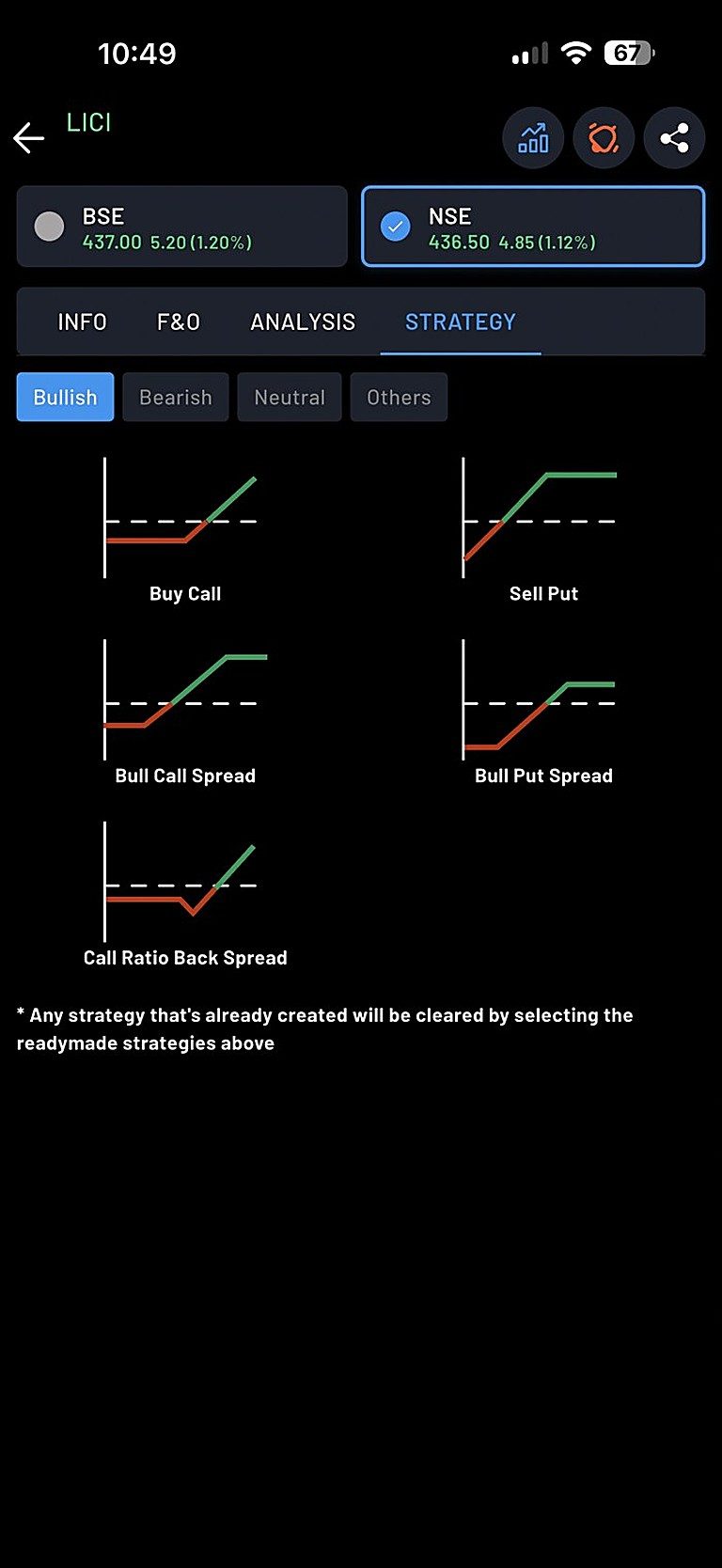
Understanding Option Trading in detail
Calls & puts, simply
A call option gives the right to buy; a put gives the right to sell — at a set strike price, on or before expiry. Buyers pay a premium and are never obligated to exercise.
Building strategies on PCJ
The in-app strategy builder lets you combine legs — such as spreads — and instantly see the pay-off diagram and Greeks, so you understand risk and reward before placing a single order.
Trade responsibly
Options are leveraged and time-sensitive — they lose value as expiry approaches. Avoid unsolicited tips, keep positions small, and prefer defined-risk strategies.
Option buyers
Option buyers have limited, defined risk (the premium paid); option sellers receive the premium but take on higher, potentially unlimited risk.
Open Demat AccountOption sellers (writers)
Option sellers (writers) collect the premium but take on higher risk.
Talk to an RMUnderstand both sides before you trade.
Why trade options with PCJ
Strategy Builder
Craft strategies with pay-off charts & Greeks.
Low, Flat Fees
Competitive, transparent pricing.
Advanced Charts
Cutting-edge charting and tools.
Multi-Leg Orders
Execute strategies as a basket.
Begin in Three Simple Steps
Open your account
Complete a 100% online, paperless Demat & Trading account in about 10 minutes.
Meet your RM
Get a dedicated Relationship Manager for guidance and service support.
Trade Options
Build a strategy, review pay-off & Greeks, and place your order.
Option Trading — Frequently Asked Questions
PCJ offers competitive, flat fees; statutory levies apply at actuals.
Options are complex and leveraged. Learn the product first and avoid trading on unsolicited tips.
Yes — use the strategy builder with pay-off charts and Greeks, and execute as a basket.
The pre-agreed price at which an option can be exercised; you choose it when placing the trade.
Yes — options lose time value as expiry nears and can expire worthless if out of the money, so manage risk carefully.
Options are complex and leveraged; learn the basics first, start small, and avoid tips-based trading.
Futures and options are contracts whose value depends on an underlying asset — a stock, index, commodity or currency pair. A future is an agreement to buy or sell at a fixed price on a future date. An option gives you the right — but not the obligation — to do so, for a price called the premium. They are tools for hedging and trading, and they carry leverage, which magnifies both profit and loss.
Very. SEBI's own study found that about nine out of ten individual F&O traders lost money, with sizeable average losses. Leverage means a small market move against you can wipe out a large part of your capital. If you still want to trade derivatives, start small, learn payoff structures, always use stop losses, and never trade with money you cannot afford to lose.
Margin is the deposit the exchange requires you to keep with the broker to take a leveraged position. It ensures you can honour your obligations if the market moves against you. Margins change with volatility, and if your losses eat into the margin, you get a margin call asking for more funds — failing which the position may be squared off.
SEBI requires brokers to collect income proof before activating derivative segments because F&O involves leverage and is suitable only for investors who can bear the risk. A recent salary slip, six months' bank statement, ITR acknowledgement or demat holdings statement usually works.
Muhurat trading is a special one-hour trading session that exchanges hold on Diwali evening, considered an auspicious time to invest. The exact timing is announced by NSE and BSE each year. It is a symbolic session — liquidity is thinner than normal hours, so trade thoughtfully.
There is no minimum. You can buy a single share, and many good companies trade at modest prices. If you prefer mutual funds, SIPs start from as little as ₹500 a month. What matters is starting early and staying regular — the amount can grow with your confidence.
In delivery trading you buy shares and hold them — they are credited to your demat account and remain yours until you sell. In intraday trading you buy and sell the same day, closing your position before the market shuts. Delivery builds long-term wealth; intraday is short-term trading that needs skill, discipline and strict stop losses.
Normal equity market hours on NSE and BSE are 9:15 AM to 3:30 PM, Monday to Friday, with a pre-open session from 9:00 to 9:15 AM. Markets are closed on exchange holidays — see our Market Holidays page for this year's full list and a live open/closed status.
A stop loss is an order that automatically exits your position if the price crosses a level you set, capping your loss. For traders it is essential — it turns an unlimited risk into a known, small one. Decide your exit level before you enter a trade, not after the price starts falling.
Yes, in most cases you can convert an intraday position to delivery before the market closes, provided you have the full funds for the purchase. The reverse is also possible subject to margins. Do note that conversion depends on the stock being available for delivery trades and on your available balance.
Ready to begin your PCJ journey?
Open a 100% online Demat & Trading account, or book a private consultation with a dedicated Relationship Manager.